The Verdict
“A charming pig-powered card dungeon-crawler that's perfect for 15-minute sessions but runs thin on long-term purpose.”
Very Positive
Fewer than 5% of Steam games with 1,000+ reviews achieve this.
Analysis by Ivan Z. Ganza · Methodology →
Quick Stats
330en
542 total (all languages)
326 analyzed
Current as of Apr 26, 2026
Dec 4, 2023
$5.99
Apr 23, 2026
0.1/day
Slowing
Metadata current as of Apr 26, 2026 · Source: Steam
Market Reach
≈14,000
≈$42.0K
Based on 542 reviews (all languages)
Based on review count × genre/age/price-adjusted Boxleiter ratio. Gross revenue before Steam’s 30% cut, refunds, and regional pricing.
Design Strengths
- Grid-based card movement where the player IS a card — a genuinely novel mechanic that enables positional strategy without complex controls
- Fast run structure scalable to 5–15 minutes, enabling both quick sessions and longer play without friction
- Emergent card interactions that reward experimentation and create unexpected in-run narratives
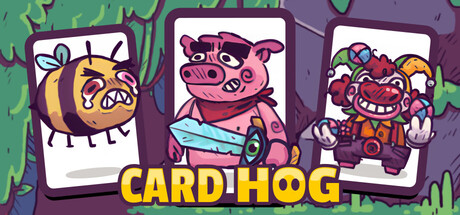
- Charming, hand-drawn art style with strong personality across every card illustration
- Low-friction death — no punishing audio or rage moments, keeping the tone relaxed and encouraging retries
- Multiple distinct game modes (Dungeon Crawl, Endless, Zombie Survival, Flame Escape, Versus) and 9 hogs with unique perks providing structural variety
- Steam Workshop integration with a card editor that lets the community extend content organically
Gameplay Friction
- Tutorial is nearly non-functional — labeled as a tutorial but only shows pointing hands for two turns, leaving card spawn rules, objectives, and progression meters unexplained
- No clear overarching goal or win condition across any mode; all modes are effectively endless variants, leaving players without a reason to push forward
- Difficulty can swing from trivially easy to overwhelming within a single turn due to uncapped enemy spawn density
- Soundtrack loops too quickly and does not evolve as gameplay progresses, prompting many players to mute audio entirely
- Individual hog perks and card interactions are not meaningfully differentiated enough — players report skills feel too similar across characters after a few runs
Audience Profile
Ideal Player
A casual-to-mid-core gamer who enjoys quick roguelite runs with emerging card synergies and a cozy, humorous aesthetic.
Casual Friendliness
high
Player Archetypes
Not For
Sentiment Trend
stable
Insufficient recent review volume to determine trend.
Genre Context
In the card-dungeon-crawler sub-genre, Card Hog's core differentiator — the player occupying a card slot on a shared grid — is a mechanical innovation not common in the roguelike deckbuilder space, which typically separates the player from the card field. However, the genre norm of meta-progression, campaign structure, and escalating unlocks is largely absent here, which places Card Hog below genre expectations for long-term engagement despite excelling at session feel.
Promise Gap
Audience Match
The store page targets players expecting dungeon-crawling breadth and multiplayer variety, but the actual audience is casual solo players seeking short, cozy roguelite sessions — the page undersells the game's strongest traits and oversells its structural depth.
Player Wishlist
- Structured campaign mode with boss-gated dungeon progression and a defined end-state
- Persistent meta-progression system (skill trees, unlockable perks, or run modifiers) to give long-term goals
- Seeded or daily challenge runs with leaderboard scoring for competitive comparison with friends
- Deeper deck-building elements giving players more agency over card pool composition before and during runs
Churn Triggers
- Players who bought for depth drop off around 2–3 hours once they realize every mode is an endless loop with no defined objective or boss-gated progression
- New players who hit the tutorial and receive no explanation of card spawn rules or objectives often disengage in the first session before mechanics click
- After roughly 3 hours, players who expected Slay the Spire-level strategic variety encounter run-to-run sameness and stop returning
Developer Priorities
Implement a structured campaign mode with boss-gated dungeon floors and a visible win condition
The single most upvoted criticism (77 helpful votes) is the absence of a 'point' to play — this is the primary churn driver and the top item on the player wishlist
Rebuild the tutorial to explicitly teach card spawn rules, grid mechanics, and objectives through guided play rather than pointer hints
14 mentions with an avg of 3.7 helpful votes; poor onboarding causes first-session dropout before the core loop hooks players
Add a persistent meta-progression layer — seeded/daily runs with scoring, or unlockable modifiers — to incentivize return sessions
Players love the core loop but stop returning after 2–3 hours without a reason to start another run; this directly addresses medium-term retention
Expand and vary the soundtrack with biome- or floor-specific tracks that evolve as runs progress
9 consistent mentions of muting the audio; audio polish is a low-hanging quality signal in a charming, aesthetic-driven game
Tune enemy spawn density cap to prevent single-turn difficulty spikes from trivial to overwhelming
Abrupt difficulty swings undercut the 'relaxing' tone that is a core design strength and cited as a friction point for 13 reviewers
Competitive Context
Most-cited genre comparator; reviewers place Card Hog in the same roguelike deckbuilder space, with one noting 'a degree of satisfaction equal to Slay the Spire' — but Card Hog's depth and session length are notably shorter
Grouped alongside Slay the Spire as a genre benchmark for deck-building roguelikes; no explicit quality comparison made
Reviewer explicitly states Card Hog offers 'more interesting strategies' than Dungeon Cards, positioning it as the superior card-dungeon crawler
Mentioned as a peer in a player's regular card-game rotation alongside Slay the Spire, indicating Card Hog competes in the same casual roguelike card space
Reviewer calls Card Hog 'probably the best thing made in GameMaker since Hotline Miami' — a strong creative endorsement rather than a genre comparison
Prior game by the same developer; some buyers credit Iron Snout brand loyalty as their reason for purchasing Card Hog
Cited as a structural peer in the card-dungeon crawler sub-genre by at least one reviewer
Referenced as a roguelike genre comparator without explicit quality judgment
One reviewer chose Card Hog over Torchlight 2 and expressed no regrets, indicating preference for Card Hog at its price point
Sentiment History
Sentiment over time
Competitive Benchmark
Compared to 233 similar games in the Strategy genre released in 2023.
Tags
Loading analytics...
Get more analyses like Card Hog
Free reports today. Pro launches soon. No spam.