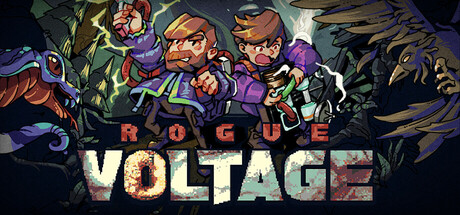
Rogue Voltage
The Verdict
“A genuinely novel circuit-wiring roguelike where planning the perfect turn feels like Apollo 13 engineering — thinky, tactile, and deeply replayable.”
Very Positive
Fewer than 5% of Steam games with 1,000+ reviews achieve this.
Analysis by Ivan Z. Ganza · Methodology →
Quick Stats
337en
525 total (all languages)
337 analyzed
Current as of Apr 23, 2026
May 10, 2024
$15.99
Apr 23, 2026
0.4/day
Slowing
Metadata current as of Apr 23, 2026 · Source: Steam
Market Reach
≈16,000
≈$250.0K
Based on 525 reviews (all languages)
Based on review count × genre/age/price-adjusted Boxleiter ratio. Gross revenue before Steam’s 30% cut, refunds, and regional pricing.
Design Strengths
- Modular wiring system is a genuinely novel mechanic — connecting generators, batteries, amplifiers, and sensors to route energy creates a puzzle-like build layer unseen in the roguelike genre
- Chain reaction payoff is deeply satisfying: planning the turn, pressing the button, and watching the cascade unfold is the game's emotional peak and a consistent driver of engagement
- 150+ modules across 9+ asymmetric characters produce 36 distinct starting loadouts, ensuring meaningful run variety without feeling arbitrary
- Puzzle-roguelike fusion rewards strategic thinking and optimization over reflexes, filling a near-empty genre niche
- Difficulty scaling from Easy to Impossible is well-tuned, letting beginners learn the system and veterans push for mastery without the game collapsing at either end
- Visual and audio feedback — module CHUNK and CRACKLE sounds, cable stretching animations — make the machine-building fantasy feel tactile and rewarding
- 'Just one more run' loop drives 50–150+ hour sessions; multiple reviewers describe it as a comfort game they return to repeatedly
Gameplay Friction
- UI fails to clearly distinguish module inputs from outputs at a glance; energy occasionally 'fizzles' with no explanation, creating confusion during wiring
- Difficulty setting is buried in the UI — at least one player with 16 hours didn't know it existed
- Late-game wiring complexity becomes unwieldy: elaborate setups require full rewiring turn-to-turn, and most run failures stem from accidental disconnected wires rather than strategic missteps
- Unlock grind is slow relative to challenge level — players beating Impossible difficulty still face a long grind for the final modules, reducing sense of meta-progression reward
- Dominant stall strategy (camping a 1-HP enemy to accumulate resources) trivializes runs and is too effective to ignore, undermining the intended challenge
- Module pool balance deteriorates as unlocks accumulate — weak modules dilute the RNG pool without counterbalancing, making the game harder and more frustrating for veteran players
- Run length feels short relative to build complexity — peak synergy is often reached just as the boss arrives, limiting time to enjoy constructed machines
Audience Profile
Ideal Player
A strategy-puzzle fan who gets more satisfaction from optimizing a system than from reflexes or narrative, and who enjoys the 'aha' moment of a chain reaction clicking into place.
Casual Friendliness
low
Player Archetypes
Not For
Sentiment Trend
declining
Sentiment dropped from 100% to 91% positive over the last 90 days (22 reviews vs 16 prior).
Genre Context
Rogue Voltage occupies an underserved niche at the intersection of engineering puzzle games and roguelike deckbuilders — a combination that is genuinely rare in the genre. Where most roguelike deckbuilders compete on card art and keyword synergies, Rogue Voltage's physical wiring metaphor creates a meaningfully different cognitive experience that reviewers consistently describe as unlike anything else in the space.
Promise Gap
Audience Match
The store page pitches 'crazy machines' and 'chain reactions' in a way that suggests accessible, action-adjacent fun, but the actual player base skews heavily toward puzzle optimizers and systems thinkers who tolerate a steep learning curve. Casual players drawn in by the 'watch chaos unfold' framing are among the most likely to churn in the first two hours.
Player Wishlist
- Undo/rewind mechanic to recover from accidental wiring mistakes without run-ending consequences
- More boss variety and endgame challenge beyond the 'Impossible' difficulty tier
- Enemy attack telegraphing (showing intent before the attack lands) to improve combat clarity
- Additional stage variety to reduce repetition in late-run biomes, particularly stage 3
Churn Triggers
- First 2–3 runs: players unfamiliar with chain reaction logic find modules feel basic and underwhelming, causing dropout before the core mechanic clicks
- Within the first 2 hours on Beginner difficulty: players who cannot form a useful chain before characters are knocked out leave a negative review and do not return
- After 15–20 hours of veteran play: discovery of the stall-on-1-HP dominant strategy makes the game feel trivial, triggering disengagement from players seeking authentic challenge
- After unlocking the majority of modules: RNG pool dilution and slow remaining unlock grind cause veterans to step away, often permanently
Developer Priorities
Overhaul the wiring UI: add clear visual language distinguishing inputs from outputs, surface the difficulty setting prominently, and add an energy-fizzle explanation tooltip
UI confusion is the single highest-friction onboarding barrier — it accelerates churn in the critical first 2-hour window and is cited across 15 reviews; fixing it costs nothing in design but recovers a meaningful slice of early dropouts
Rebalance the module unlock pool — weight late-unlock modules toward useful tiers or add a filter/ban mechanic, and increase unlock pacing for veteran players who have already beaten Impossible
RNG pool dilution and slow unlock grind are the two primary veteran churn triggers; they affect the most engaged players (20+ hours) and are the clearest driver of the recent sentiment dip from 100% to 91%
Patch the dominant stall-on-1-HP strategy — introduce an enemy mechanic, timer pressure, or incentive that makes finishing enemies promptly the correct play
The exploit trivializes runs and is 'too good to ignore,' converting what should be a strategic peak into a boring chore; it actively undercuts the core fantasy and is cited in high-helpfulness negative reviews
Add an undo/rewind mechanic (at least for deterministic wiring steps) to prevent accidental disconnected-wire run failures
Most late-game run losses are attributed to wiring errors rather than strategic mistakes; this directly undermines the skill-expression fantasy and is the top requested feature from long-session players
Improve the onboarding tutorial to make chain reaction logic clear before the first fight, and ensure Beginner difficulty produces at least one satisfying chain in run 1
The game's most common dropout moment is runs 1–3 where players don't yet understand chain reactions; the mechanic is brilliant but invisible until it clicks — a guided first chain would convert more trials to retained players
Competitive Context
Most frequent comparison; reviewers cite Rogue Voltage as a genuinely novel take on the roguelike deckbuilder with similar long-term appeal but a fundamentally different skill expression. Enemy intent telegraphing from StS is frequently requested as an improvement for Rogue Voltage's combat clarity.
Cited as a direct design lineage — reviewers describe the game as a hybrid of Zachtronics engineering puzzles and roguelikes, with the wiring system scratching the same circuit-design itch.
Compared favorably for puzzle-like turn-based depth; one reviewer calls it 'the eurorack version of Into the Breach,' highlighting the shared emphasis on complete information and system mastery.
Reviewers with 45+ hours invoke Factorio-level obsession and compare the spaghetti circuit-building aesthetic to Factorio's manual wiring, signaling appeal to automation-puzzle fans.
Referenced as a comparable tactical tableau-builder; reviewers note Rogue Voltage rewards turn-by-turn strategic thinking more cleanly and avoids Backpack Heroes' catch-all solution problem.
Mentioned alongside other synergy-driven roguelikes as part of the competitive genre set.
Cited as a comparable roguelike deckbuilder with satisfying build interactions, positioning Rogue Voltage within the premium indie roguelike tier.
Sentiment History
Sentiment over time
Playtime Sentiment
Sentiment by time invested
· 337 post-launch reviewsSentiment is consistent across all playtime ranges — players feel the same way whether they've played 2 hours or 200.
Competitive Benchmark
Compared to 405 similar games in the Strategy genre released in 2024.
Tags
Loading analytics...
Get more analyses like Rogue Voltage
Free reports today. Pro launches soon. No spam.