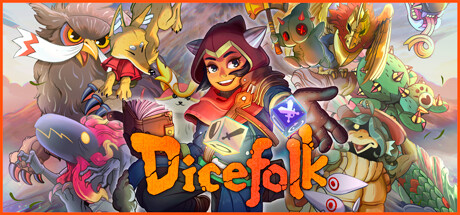
Dicefolk
by LEAP Game Studios·published by Good Shepherd Entertainment
The Verdict
“A charming, clever dice-and-monster roguelite that shines for 15–25 hours before its shallow run variety wears thin.”
Very Positive
This puts the game in the top 30% of all reviewed games on Steam.
Analysis by Ivan Z. Ganza · Methodology →
Quick Stats
482en
994 total (all languages)
479 analyzed
Current as of Apr 27, 2026
Feb 27, 2024
$14.99
Apr 23, 2026
0.5/day
Slowing
Metadata current as of Apr 27, 2026 · Source: Steam
Market Reach
≈29,000
≈$230.0K
Based on 994 reviews (all languages)
Based on review count × genre/age/price-adjusted Boxleiter ratio. Gross revenue before Steam’s 30% cut, refunds, and regional pricing.
Design Strengths
- Dual-control dice sequencing — controlling both player and enemy turn order creates a puzzle-like layer that meaningfully reduces RNG frustration while rewarding planning
- 100+ hand-drawn Chimera with distinct abilities generate genuine team-building creativity and visual delight run-to-run
- Synergy and combo system depth produces wildly satisfying 'broken build' moments that keep mid-range players engaged for 20+ hours
- Intuitive tutorial and UI make the game accessible to roguelite newcomers without lengthy onboarding
- Addictive 'one more run' loop reinforced by a cozy, low-stress atmosphere suitable for casual sessions
- Trials/ascension system rewards players who push difficulty with additional perks, avoiding the tedium of flat stat scaling
- Seamless audio design with music that transitions between screens rather than restarting, enhancing immersion
- Steam Deck verified with confirmed smooth performance, broadening playtime contexts
Gameplay Friction
- Significant chimera balance disparity — a clear tier of 'good vs. useless' creatures funnels experienced players into predictable team compositions, especially on higher difficulties
- Only 3 choices per floor (one chimera recruit, items seen without selection pressure) leaves experienced roguelike players feeling starved of meaningful mid-run decisions
- Base difficulty is too low for genre veterans; many report winning the first several runs without a single loss, reducing stakes
- Slow animation and UI transition speeds outside of battle have no speed-control option, creating pacing drag in non-combat screens
- Disabled dice lack clear visual feedback, causing repeated misclicks and UI confusion that persists across multiple full runs
- Items received as rewards cannot be sold or discarded, creating dead-weight inventory with no recourse when items don't fit the build
- Clan/faction deck contents cannot be previewed before starting a run, forcing blind commitment to a playstyle
Audience Profile
Ideal Player
A casual-to-mid-core roguelite fan who enjoys creature-collecting aesthetics, light puzzle-style combat, and cozy 'one more run' sessions without punishing complexity.
Casual Friendliness
high
Player Archetypes
Not For
Sentiment Trend
stable
Sentiment steady at ~100% positive over the last 180 days (23 reviews).
Genre Context
Dicefolk competes in the roguelite deckbuilder subgenre against well-established benchmarks, and its dual-control dice sequencing is a genuinely novel mechanical contribution — not a reskin. However, it underdelivers on per-run decision density compared to genre leaders, which expect 15–30 meaningful choices per floor rather than 3; closing this gap is the clearest path to retaining the experienced segment of the audience.
Promise Gap
Audience Match
The store page leans into creature-collector and team-builder fantasy with language targeting fans of deep customization, but the actual audience skews toward casual roguelite players who value cozy atmosphere and accessible strategy over build-crafting depth; experienced deckbuilder veterans drawn in by the Slay the Spire-adjacent framing frequently report unmet expectations around decision density.
Player Wishlist
- Creature leveling or evolution system (XP gain per fight, evolution stones) to add progression depth within and across runs
- Item selling or discarding mechanic at shops to give players agency over unwanted rewards
- Starting team or deck preview/selection before committing to a run
- Additional event types and boss variety to diversify floor encounters beyond the current limited pool
- Mobile port to extend play into on-the-go contexts
- Easier shiny chimera acquisition or dedicated shiny-hunting mechanic for collectors
Churn Triggers
- Veteran roguelike players who win their first 5–10 runs without a loss disengage before reaching the Trials system, concluding the game has no challenge
- After 15–30 hours, players who have unlocked all chimera and challenge tiers hit a visible content wall and stop returning, citing no new surprises remaining
- Within the first 2–3 runs, players who find the 3-choices-per-floor structure insufficient drop the game before synergy depth becomes apparent
- Players encountering the confirmed crash bug (6th consumable die or specific enemy attacks) abandon the session immediately and do not return
Developer Priorities
Ship a balance pass targeting the chimera tier list — buff underperforming creatures to be viable outside niche combos, nerf the top 5–10 dominant picks at high Trial levels
The most-upvoted critical review (132 helpful votes) centers on this exact failure; it directly causes run homogeneity and is the primary reason experienced players churn at 20–30 hours
Increase meaningful per-floor decisions — add branching paths, event nodes, or expand chimera selection to 4–5 choices with discard penalties to create real selection pressure
20 reviews from experienced genre players identify the 3-choices-per-floor structure as the core depth problem; fixing this extends the engagement window for the audience most likely to recommend the game publicly
Fix the 6th consumable die crash and the specific enemy attack crash — ship a targeted patch and publicly acknowledge the fixes in a Steam update post
Unresolved crashes are the primary refund driver and damage developer credibility; one review explicitly cites developer unresponsiveness on a crash as the reason for a negative review
Add a speed toggle for all out-of-battle UI transitions and animations (map traversal, shrine screens, reward screens)
Slow non-battle pacing is flagged as friction in 14 reviews; one reviewer explicitly calls it an 'anti-refund strategy,' which is reputationally damaging even if unintended
Publish a public content roadmap — even a minimal one indicating whether new chimera, events, or modes are planned
Developer silence post-launch is cited as a reason players have mentally closed the book on the game; a roadmap costs near-zero effort but signals the game is alive and can revive wishlist conversions
Competitive Context
Most frequent benchmark. Reviewers credit Dicefolk's dice mechanic as a fresh alternative but consistently note it offers fewer meaningful choices per floor, making runs feel less decision-dense than Slay the Spire's card-selection pressure.
Reviewers frame Dicefolk as 'Pokémon meets roguelike' and several say it captures creature-collecting fantasy better than mainline Pokémon does in its current state; shiny variants reinforce the comparison positively.
Cited as the closest dice-mechanic peer; some reviewers find Dicefolk superior in creature variety, others note it lacks Dicey Dungeons' long-term mechanical complexity.
Peer in the cute-aesthetic strategic roguelite space; Dicefolk is rated easier to pick up with less punishing RNG, but one reviewer places it below Wildfrost in overall strategic depth.
Referenced as a deckbuilder peer; one reviewer found Dicefolk via a Monster Train recommendation, another notes faction visual differentiation is less distinct than Monster Train's.
Cited specifically for the shared mechanic of playing around visible enemy intentions; Dicefolk's dice sequencing is seen as a spiritual extension of that design philosophy.
A reviewer experienced with dice-builder roguelikes including Astrea rates Dicefolk as excellent, highlighting its creature-collection depth as a differentiator in the subgenre.
One reviewer draws a structural parallel to Slice & Dice's dice-based roguelike format without favoring either.
Sentiment History
Sentiment over time
Playtime Sentiment
Sentiment by time invested
· 482 post-launch reviewsSentiment is consistent across all playtime ranges — players feel the same way whether they've played 2 hours or 200.
Competitive Benchmark
Compared to 417 similar games in the Strategy genre released in 2024.
Tags
Loading analytics...
Get more analyses like Dicefolk
Free reports today. Pro launches soon. No spam.