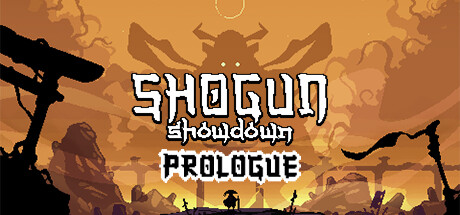
Shogun Showdown: Prologue
by Roboatino·published by Goblinz Publishing
The Verdict
“A razor-sharp free roguelite prologue that makes you feel like a tactical genius — until you realize you want ten more hours of it.”
Very Positive
Fewer than 5% of Steam games with 1,000+ reviews achieve this.
Analysis by Ivan Z. Ganza · Methodology →
Quick Stats
315en
678 total (all languages)
311 analyzed
Current as of Apr 24, 2026
Apr 4, 2023
Free
Apr 23, 2026
0.3/day
Slowing
Metadata current as of Mar 22, 2026 · Source: Steam
Market Reach
Free-to-play — revenue estimates don't apply.
Design Strengths
- 1D positional combat — constraining movement to a single axis creates puzzle-like tension that rewards spatial thinking on every turn
- Tile/card queuing with priority — the player-always-goes-first rule makes the system feel fair and keeps control legible even under pressure
- Combo execution feedback — chaining tiles into multi-kill turns delivers satisfying payoff that drives repeated playthroughs
- Deck-building with weapon variety — sword, spear, bow, and others follow distinct spatial logic, enabling meaningfully different build paths each run
- Pixel art and animation polish — fluid character animations and a cohesive samurai aesthetic punch well above the game's free price point
- Original mechanic twist in a crowded genre — 1D tile-shifting and enemy-attack redirection feel genuinely fresh to veterans of roguelites and deck-builders
- Soundtrack quality — music praised as funky and atmospheric, elevating overall production feel beyond typical indie demo standards
- Easy-to-learn rule surface — new players can grasp core mechanics within minutes while meaningful strategic depth stays available for mastery
Gameplay Friction
- Difficulty too low — health potion drops are excessively common, making damage negligible and most runs a foregone conclusion before the final boss
- Controls lack shortcut depth — no number-key bindings for card selection forces slower input than the tactical speed warrants, causing accidental mis-queues
- Tutorial leaves item usage unexplained — consumables on the left panel go unnoticed for multiple runs, creating silent friction rather than discovery
- Boss attack patterns are formulaic — each boss follows the same summon/ranged/melee template, reducing late-run tension
- UI info mode requires a separate toggle — contextual info locked behind a mode switch instead of always-on tooltips interrupts decision flow
- Run variation feels shallow to genre veterans — upgrades and abilities don't alter core loop enough to prevent repetition across extended play sessions
Audience Profile
Ideal Player
A strategy-hungry player who loves finding elegant combos in tight systems and doesn't mind short, replayable runs on their lunch break.
Casual Friendliness
medium
Player Archetypes
Not For
Sentiment Trend
stable
Insufficient recent review volume to determine trend.
Genre Context
In the crowded turn-based roguelite/deck-builder space, Shogun Showdown earns consistent comparison to genre-defining titles by virtue of its mechanical originality — the 1D positional constraint is a genuine design innovation rather than a genre remix. For a free prologue, production quality and strategic depth significantly exceed category norms, though content volume is appropriately scoped as a conversion tool rather than a standalone product.
Promise Gap
Audience Match
The store description accurately targets strategy and roguelite players who will engage with positioning and deck-building systems. The audience who shows up matches the one described, though the store page undersells the mechanical originality that most drives conversion.
Player Wishlist
- Cinematic replay feature — ability to rewatch a completed run as a fluid battle sequence
- Harder difficulty modifiers or challenge modes within the prologue itself
- Progress or unlock carryover from prologue to the full game
- More rule-bending or exotic attack tiles that break the established spatial logic in surprising ways
- Additional consumable item types beyond health potions
Churn Triggers
- Players who clear the single-character prologue run in 20–30 minutes hit a hard content wall immediately and drop off with no further loop to pursue
- New players who cannot determine the control scheme within the first minutes of play exit before experiencing core mechanics
- Genre veterans who complete two or three runs without observing meaningful variation in upgrade paths disengage before the difficulty spike of the final boss
Developer Priorities
Tune difficulty — reduce health potion drop frequency and add at least one hard-mode modifier or curse system
The most-upvoted criticism in the dataset; runs feel consequence-free, which undercuts the roguelite tension the game is built to deliver and leaves players with no reason to engage carefully
Add controller support and fix Steam Deck UI clipping before any major full-game promotional push
Steam Deck is listed as Playable but the lack of controller input makes the game unplayable on device — this is a platform promise the product currently cannot keep and will cost conversion among Deck owners
Expand the attack tile roster with rule-breaking or exotic tiles that alter spatial logic for the full game
Genre veterans explicitly warn the loop will go stale without escalating mechanical variety; this is the primary long-term replayability risk for the full release
Revise the tutorial to surface item usage and improve keyboard shortcut onboarding
Players missed the consumable panel for multiple runs — silent confusion early in a demo costs conversion; better onboarding directly raises the chance first-session players reach the satisfying combo moments
Diversify boss attack patterns with at least two distinct encounter templates
The current summon/ranged/melee formula makes all bosses feel identical, flattening the climactic moment of each run and reducing incentive for repeat attempts
Competitive Context
Multiple reviewers cite Slay the Spire as the quality benchmark Shogun Showdown approaches or matches; framed as high praise for deck-building depth and overall polish
Reviewers describe the 1D tile-shifting and enemy-attack-redirection as Into the Breach distilled to one dimension — consistently framed as a favorable and original design distinction
One reviewer labels it 'Pixel Darkest Dungeon' to communicate genre and aesthetic similarity without expressing preference
Compared for micro-turn-based feel and rhythm of play; no explicit preference stated
Cited as a structural roguelike parallel; reviewer notes strategic similarity without favoring either game
Referenced for roguelike structure comparison; no valence claim beyond genre classification
Implied competitive-set reference in genre discussion; no explicit preference or comparison stated
Implied in indie quality discussion; no explicit valence claim beyond genre adjacency
Sentiment History
Sentiment over time
Playtime Sentiment
Sentiment by time invested
· 314 post-launch reviewsSentiment is consistent across all playtime ranges — players feel the same way whether they've played 2 hours or 200.
Competitive Benchmark
Compared to 150 similar games in the Strategy genre released in 2023.
Tags
Loading analytics...
Get more analyses like Shogun Showdown: Prologue
Free reports today. Pro launches soon. No spam.