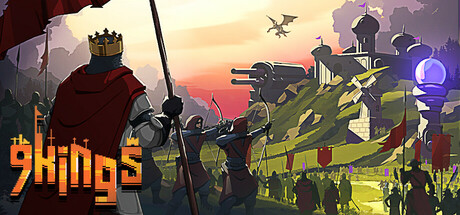
The Verdict
“A dangerously addictive roguelike kingdom-builder where breaking the game is the point — if quest RNG doesn't break you first.”
Very Positive
This puts the game in the top 30% of all reviewed games on Steam.
Analysis by Ivan Z. Ganza · Methodology →
Quick Stats
9,569en
21,048 total (all languages)
1,996 analyzed
Current as of Apr 27, 2026
May 23, 2025
$19.99
Apr 23, 2026
22.1/day
Slowing
Metadata current as of May 4, 2026 · Source: Steam
Market Reach
≈590K
≈$5.9M
Based on 21,048 reviews (all languages)
Based on review count × genre/age/price-adjusted Boxleiter ratio. Gross revenue before Steam’s 30% cut, refunds, and regional pricing.
Design Strengths
- Nine mechanically distinct kings each with unique cards, units, and buildings create genuine variety and extensive learning curves
- Intentional 'break the game' design — exponential scaling and mass-replication combos (178k slimes, singularity wizards) are the reward, not a bug
- 20–30 minute run length enables bite-sized sessions that still feel complete and replayable
- Cross-king card looting system adds a strategic meta-layer, letting players blend rival decks for unexpected synergies
- Pixel art conveys satisfying unit impact despite minimal sprite size; card art and king personalities add character
- Quest mode (81 scenarios) forces creative strategies and prevents meta-progression from dominating, functioning as puzzle endgame content
- Turn-based pacing makes the game genuinely playable as a background/second-monitor experience without losing strategic depth
- Frequent, meaningful Early Access updates with developers visibly acting on player feedback
Gameplay Friction
- Quest mode is excessively RNG-dependent post-patch — specific quests (Restructuring, Rubble Kingdom, Blood Money, Blitz, Deforestation) require precise card draws in turns 1–3, forcing 10–30+ restarts per mission
- Card pool convergence at higher difficulty: only 4–5 cards (Gigantify, Unify, Echo Form, Rewind, Offering, Replicators) remain viable, making the rest of the pool feel irrelevant
- Percentage-based perks are mathematically useless at low stat values early in progression, and pre-run perk selection can lock players into a build before the roguelike choice begins
- No board visibility during card drafting — players cannot review their current setup while selecting new cards, a significant miss for min-max decisions
- Tutorial and tooltips are insufficient for hidden mechanics: card self-leveling, enchantment vs. tome distinction, and Nomad King unit interactions are discovered only after many hours
- Endless mode does not award level-up points, removing a key progression incentive for long-session play
- Quest retry flow is cumbersome, amplifying frustration when RNG-dependent missions require many consecutive restarts
Audience Profile
Ideal Player
A fan of synergy-hunting roguelikes who wants short, replayable sessions with exponential power fantasies and a cozy second-monitor vibe.
Casual Friendliness
high
Player Archetypes
Not For
Sentiment Trend
declining
Sentiment dropped from 93% to 87% positive over the last 90 days (719 reviews vs 1277 prior).
Genre Context
In the roguelike deckbuilder genre, 9 Kings occupies a distinct niche as a tiled auto-battler kingdom-builder rather than a traditional card combat game, offering a wider casual audience than pure deckbuilders while delivering the synergy depth the genre demands. The 'break the game' design philosophy and exponential scaling are genre-leading strengths, but the card pool viability gap at high difficulty is a known genre-wide problem that 9 Kings has not yet solved — most mature competitors in this space have addressed it through broader card rebalancing passes.
Promise Gap
Audience Match
The store page targets players seeking deep strategic complexity ('build your city,' 'strategic ways,' 'survive decades of war'), but actual players skew toward cozy roguelike fans who want addictive short sessions and power-fantasy number scaling rather than deliberate long-term strategy. The description also implies more build diversity than high-difficulty play delivers.
Player Wishlist
- PvP or asynchronous multiplayer mode to add strategic competition between kingdoms
- Additional kings beyond the current nine to expand playstyle variety
- Steam Workshop support for community-created kings, cards, and scenarios
- Custom deck-building mode allowing pre-run card selection rather than full draft randomness
- Speed shortcuts or auto-targeting options for late-game turns with large unit counts
- Experience or progression rewards for failed quest attempts to reduce the sting of repeated restarts
Churn Triggers
- Players who exhaust all nine kings within 5–30 hours and discover that optimal strategies converge to the same 4–5 cards hit a wall where runs feel identical — dropout occurs at this sameness threshold
- New players encounter quest mode after investing 10–40 hours in standard runs and immediately face a patch-broken near-impossible mission, triggering abandonment at what should be the content reward
- Players who reach 150–200 hours and have completed all 54 achievements and all quests report leaving due to nothing left to do — content ceiling is hit by dedicated players without a clear endgame
Developer Priorities
Rebalance quest mode RNG dependency — audit and fix the 6+ quests (Restructuring, Rubble Kingdom, Blood Money, Fugitive, Blitz, Deforestation) identified as requiring turn 1–3 luck to be completable
The single highest-voted negative signal (95+ helpful votes on top review); quest mode is supposed to be the endgame content reward but is now the primary negative review driver and is directly causing the sentiment decline
Broaden viable card pool at higher difficulties — reduce the dominance of 4–5 multiplicative cards (Gigantify, Unify, Echo Form) by buffing underused cards or capping multiplicative stacking
164-helpful-vote review explicitly calls this out; it is the primary long-term engagement killer, converting players from optimizers to quitters and collapsing perceived build diversity to a slot machine
Implement a unit count performance cap or progressive frame throttle to prevent crashes when replication builds reach 30k+ units — especially for Deforestation and Greed Revolution quests
Crashes destroy run progress and are the primary negative technical experience; some quests have near-100% crash rates at boss fights, and the 'break the game' brand promise is undercut when the game actually breaks
Fix Steam Deck touch input freeze during expansion events and restore trackpad controls broken by recent updates
Steam Deck Verified badge creates an expectation of full functionality; touch freeze forces full restart and progress loss — a 56-helpful-vote review signals this affects a meaningful Deck audience segment
Add board visibility during card drafting and expand tooltips to cover hidden mechanics (self-leveling, enchantment vs. tome, Nomad King synergies)
Missing board view during drafting is a direct contradiction of the game's min-max identity; tooltip gaps create a silent dropout funnel for new players who don't know what they're building toward
Competitive Context
Most frequent comparison; players describe 9 Kings as 'what if Balatro was an auto-battler' — similar addictive synergy loop and exponential number scaling. One reviewer claims 9 Kings surpasses Balatro.
Compared as a peer roguelike deckbuilder; 9 Kings praised for capturing STS's 'busted build' moments. Noted as more accessible but with less tactical ceiling.
Players cite similar dopamine loop and exponential scaling; 9 Kings offers more strategic agency through drafting and positioning.
Compared favorably for bite-sized runs with exponential scaling, but one reviewer coins 'Risk of Rain Syndrome' — unique king traits vanish at high difficulty as players converge on dominant strategies.
9 Kings described as scratching the same itch via army-building and tile-placement mechanics.
Recommended as a more polished and complete alternative by a subset of negative reviewers.
Player notes similar feel but characterizes 9 Kings as 'checkers' to Into the Breach's 'chess' — less chess-like positioning depth.
Players suggest 9 Kings has similar depth and potential to become a genre classic with continued development.
Cited as a copycat that attempts 9 Kings' formula but fails in execution — used to validate 9 Kings as the genre originator.
Sentiment History
Sentiment over time
Playtime Sentiment
Sentiment by time invested
· 9,551 post-launch reviewsSentiment is consistent across all playtime ranges — players feel the same way whether they've played 2 hours or 200.
Competitive Benchmark
Compared to 467 similar games in the Strategy genre released in 2025.
Tags
Loading analytics...
Get more analyses like 9 Kings
Free reports today. Pro launches soon. No spam.