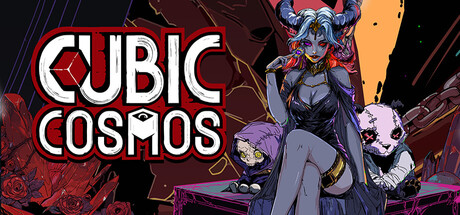
Cubic Cosmos
by Inkstone Atelier·published by Lilith Games
The Verdict
“A wildly creative roguelike deckbuilder that rewards breaking the game with absurd combos — seriously underplayed for its quality.”
Very Positive
This puts the game in the top 30% of all reviewed games on Steam.
Analysis by Ivan Z. Ganza · Methodology →
Quick Stats
78en
677 total (all languages)
78 analyzed
Current as of Apr 23, 2026
Sep 16, 2025
$12.99
Apr 23, 2026
0.2/day
Slowing
Metadata current as of Apr 23, 2026 · Source: Steam
Market Reach
≈19,000
≈$250.0K
Based on 677 reviews (all languages)
Based on review count × genre/age/price-adjusted Boxleiter ratio. Gross revenue before Steam’s 30% cut, refunds, and regional pricing.
Design Strengths
- Intentional 'no balance cap' philosophy lets decks snowball into absurdly powerful combo chains — framed universally as a feature, not a bug
- Back-to-front monster attack targeting system adds a spatial layer absent from most genre peers
- Stat-stacking system allows multiple enhancements to concentrate on a single card, enabling genuinely distinct build archetypes each run
- 12 heroes across 3 classes each have unique synergy sets that meaningfully alter deck strategy and replayability
- 240+ cards and 50+ relics provide enough combinatorial space to sustain 45+ hour playthroughs without repetition fatigue
- Doll Code system enables cross-player pawn sharing, adding a passive social layer unusual in single-player deckbuilders
- Dark/gothic art style and animations praised as polished well beyond the typical indie card battler production bar
- Engaging tutorial successfully introduces complex mechanics without feeling tedious
Gameplay Friction
- Doll system and keyword interactions are poorly explained — players report winning 5 runs without understanding what the doll system does
- Keyword tooltips on cards sometimes add complexity rather than clarifying meaning, making card text harder to parse
- Cascading chain reactions become cognitively overwhelming — players describe watching their board get wiped and having no idea why
- Late-stage balance is severely skewed: only one hero scales adequately to meet high difficulty, creating a death spiral for all others
- Metaprogression outside the Doll system is minimal, offering little mitigation for players struggling with difficulty spikes
- Steam Deck controls have unresolved buggy input issues despite the game being rated Playable
- Ascend card screen UI lacks visual impact and polish relative to the rest of the game
Audience Profile
Ideal Player
A deckbuilding enthusiast who gets more joy from engineering ridiculous 100-action combo chains than from carefully balanced, skill-tested progression.
Casual Friendliness
medium
Player Archetypes
Not For
Sentiment Trend
stable
Insufficient recent review volume to determine trend.
Genre Context
In a saturated roguelike deckbuilder market dominated by polish-first clones, Cubic Cosmos distinguishes itself through a deliberate anti-balance philosophy and spatial combat mechanics (back-to-front targeting) that most peers do not attempt. At $12.99 in Early Access with 240+ cards and 12 heroes, the content-to-price ratio sits above genre median, though the difficulty imbalance at high-tier play is a known weakness across many indie entries in this space.
Promise Gap
Audience Match
The store page uses 'fast-paced' and 'tower defense' language that attracts action-oriented players, but the actual audience skews toward deliberate combo-crafters and deckbuilding optimizers who want to engineer broken builds over multiple long sessions. The 'tower defense' label in particular is absent from reviewer descriptions and may set incorrect expectations.
Player Wishlist
- Additional heroes, cards, and relics beyond current content (requested by invested players at 20–45+ hours)
- A glossary or in-game reference for card terminology and keyword definitions
- More enemy variety and distinct boss encounters to support higher difficulty levels
- Expanded metaprogression system beyond Dolls to reward repeated runs
Churn Triggers
- Early sessions: players unfamiliar with the doll system and keyword interactions feel lost before the first win, risking dropout before the game clicks
- First high-difficulty attempt: players trying non-scaling heroes hit the death spiral wall and abandon the run — and sometimes the game — without understanding why they failed
- ~0–1 hours: the complexity of simultaneous chain reactions overwhelms some players before they learn to track cascades, leading to immediate negative reviews
- Post-completion plateau: hardcore players who unlock all characters and clear the hardest difficulty without a loss report nothing left to engage with and disengage
Developer Priorities
Audit and rewrite all keyword tooltips and add a searchable in-game glossary; explicitly tutorial-ize the Doll system within the first run
7 reviews flag unclear mechanics as friction; the Doll system — a core progression feature — remains opaque even to players who have won 5 runs. This is the highest-frequency early-dropout cause.
Rebalance hero scaling at late difficulty levels so that at least 3–4 heroes (not just one) can viably reach high-difficulty clears without a death spiral
The single-hero viability ceiling is a hard ceiling on long-term retention; players who discover it after investing 20+ hours report feeling the game has no replay depth at difficulty extremes
Add a combat log or step-by-step chain replay UI so players can trace what triggered a cascade wipe
Cascade opacity is the primary friction for players who bounce off the game early; it also affects longer-session players trying to understand failed combo sequencing
Prioritize a content drop (new heroes, cards, or a new class) to re-engage lapsed players and generate review velocity
Review velocity has dropped to 1/month; a content update would give existing fans a shareable reason to return and post, directly addressing the game's discovery problem
Fix fullscreen resolution defaulting to 4:3 and audit Steam Deck input bindings for control bugs
Fullscreen and Steam Deck are both entry-point experiences; a broken first impression at launch or on portable play causes fast exits before the game's strengths are visible
Competitive Context
Used as the primary genre benchmark; reviewers explicitly praise Cubic Cosmos for abandoning StS-style balance caps in favor of chaotic power scaling. One player calls it the best RLDB since StS and Monster Train.
Named alongside StS as the last comparable quality bar; the comparison positions Cubic Cosmos as a genre-tier peer, not a clone.
Reviewer with 45 hours highlights card modifier mechanics not seen since Inscryption, framing Cubic Cosmos as a spiritual successor in that design space.
Reviewers describe Cubic Cosmos as a better version of Hearthstone with interesting ability automation, framing the comparison favorably.
Compared favorably to LOR:POC before power creep set in, suggesting Cubic Cosmos captures that game's early appeal.
Referenced as a mechanic analogy for understanding the synergy system; no direct quality comparison made.
Cited as a genre touchstone for mechanical DNA alongside Hearthstone and Slay the Spire; not a direct quality comparison.
Sentiment History
Sentiment over time
Playtime Sentiment
Sentiment by time invested
· 78 post-launch reviewsSentiment is consistent across all playtime ranges — players feel the same way whether they've played 2 hours or 200.
Competitive Benchmark
Compared to 618 similar games in the Strategy genre released in 2025.
Tags
Loading analytics...
Get more analyses like Cubic Cosmos
Free reports today. Pro launches soon. No spam.