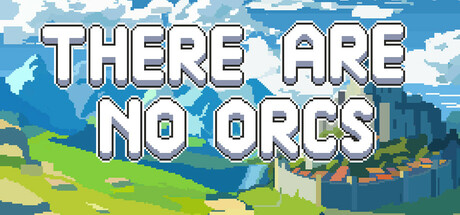
There Are No Orcs
by BaseTrade Studio·published by Gamirror Games
The Verdict
“A $9 castle-fight auto-battler with 30 commanders, addictive building synergies, and a "just one more run" loop that runs thin around hour 30.”
Very Positive
Fewer than 5% of Steam games with 1,000+ reviews achieve this.
Analysis by Ivan Z. Ganza · Methodology →
Quick Stats
412en
969 total (all languages)
479 analyzed
Current as of May 22, 2026
Nov 5, 2025
$9.43
May 22, 2026
1.8/day
Slowing
Metadata current as of Mar 23, 2026 · Source: Steam
Market Reach
≈24,000
≈$220.0K
Based on 969 reviews (all languages)
Based on review count × genre/age/price-adjusted Boxleiter ratio. Gross revenue before Steam’s 30% cut, refunds, and regional pricing.
Design Strengths
- 30 commanders across three factions (Humans, Demons, Dwarves) each with distinct buildings, passives, and actives — switching factions genuinely feels like learning a new game
- Building adjacency synergy system creates a satisfying economy puzzle where placement decisions compound into emergent, sometimes absurd power combinations
- Auto-battler format lets players engage passively or optimize aggressively, supporting both chill and min-max playstyles with the same core loop
- Chaos mode whims (unique per-level modifiers like 'all units have 1 HP' or 'all enemies are ducks') add meaningful strategic variation beyond simple stat inflation
- Charming, readable pixel art clearly communicates unit and building roles at a glance, supporting the information-dense strategy layer
- Responsive developer iteration — bug fixes shipped within hours of reports, building community trust early post-launch
Gameplay Friction
- Base difficulty is critically low — many players report winning without losing a single match before unlocking Chaos mode, removing any early tension from the core loop
- Demon faction (particularly Xerth commander and Lemure units) is severely overpowered at low-to-mid Chaos levels, enabling trivial sub-8-minute wins through spam and making balance feel unfinished
- Equipment and relic system feels incremental rather than build-defining — stat bonuses like '+2 ranged damage' or '+100 starting gold' don't create meaningful identity; some relic combinations break high Chaos entirely
- Enemy AI and opponent faction variety are shallow compared to the player's arsenal — CPU opponents behave repetitively and don't mirror the strategic depth players have, making matches feel asymmetric
- UI lacks key rebinding, windowed mode has resize limitations, building descriptions are unclear, and there is no pre-placement queue for rapid building deployment — players report spending more time clicking than watching battles
- A dominant 'build fast' macro strategy reduces decision-making depth over time, with battle math simple enough to win without deliberate unit composition planning
Audience Profile
Ideal Player
A strategy fan who loves solving economy puzzles, enjoys unlocking a wide roster, and wants a chill but cerebral session game they can play alongside a podcast.
Casual Friendliness
high
Player Archetypes
Not For
Sentiment Trend
stable
Sentiment steady at ~95% positive over the last 180 days (327 reviews).
Genre Context
Auto-battler/base-builder hybrids typically differentiate on roster depth and run variety; TANO's 30-commander asymmetric design sits above the genre median on faction variety but below on endgame difficulty scaling, where the best titles sustain challenge well past 50 hours. The $9 price point undercuts most comparable genre entries while matching or exceeding their content volume.
Promise Gap
Audience Match
The store page targets players seeking intense tactical combat ('smash enemies to smithereens', 'unstoppable front line'), but the audience who actually loves the game skews toward relaxed optimizers who enjoy puzzle-like economy building at their own pace. Competitive-challenge seekers attracted by the store copy are the most likely to leave negative reviews.
Player Wishlist
- PvP multiplayer (1v1, 2v2) — the tug-of-war mechanics are widely seen as a natural fit for competitive play, with Castle Fight/SC2 custom maps cited as the target experience
- More maps beyond the current four main levels — players want layout variety that changes strategic priorities
- Additional playable factions and enemy commanders with the same depth as existing player factions
- Expanded endgame modes beyond Chaos and Survival — players who hit Chaos 100 report no meaningful goal remaining
- Co-op play alongside a friend against AI enemies
Churn Triggers
- Within the first 2–4 hours, players who never lose a match — enabled by the low base difficulty — disengage before reaching Chaos mode, perceiving the game as too shallow to continue
- Around hours 20–36, after exhausting 2–3 favorite commanders, players hit a content ceiling and report 'reaching the end too early' without incentive to explore the remaining roster
- Upon unlocking Survival mode (~10–24 hours in), a single run floods players with thousands of fragments, collapsing the gear progression loop that previously motivated continued play
- At high Chaos levels, sudden unkillable enemy champion spam at 40% castle HP creates frustration spikes that cause players to abandon otherwise successful runs
Developer Priorities
Rework difficulty scaling: raise base game floor and tune mid-Chaos balance, specifically nerfing the Demon/Lemure/Xerth cheese loop that trivializes content up to Chaos 30+
Low difficulty is the single most upvoted complaint (58 helpful votes on top negative review) and the primary early-churn driver — fixing it retains players who currently disengage in the first 2–4 hours without reaching the game's best content
Redesign the equipment/relic progression to make gear feel build-defining rather than incremental — introduce identity-shaping legendary relics and fix the Survival fragment flood that collapses the progression loop
Weak gear is the second-most-upvoted complaint (50 helpful votes) and the Survival fragment overflow destroys the entire power-level motivation that keeps mid-game players engaged past hour 20
Add a post-Chaos-100 endgame goal structure — scored leaderboard runs, achievement challenges per commander, or an unlockable hard mode that resets gear — to give high-hour players a reason to continue
Players who love the game and reach Chaos 100 report nothing left to pursue; they leave satisfied but passively, missing an opportunity for the game to generate ongoing reviews and word-of-mouth from its most engaged fans
Increase enemy faction strategic variety — give CPU opponents distinct commander behaviors, unit compositions, and building patterns that mirror the asymmetry players have
Repetitive CPU behavior is a noted friction point that accelerates the sense of sameness in extended play sessions; richer enemy variety extends the middle of the content curve without requiring new factions
Ship targeted UI/QoL improvements: key rebinding, building pre-placement queue, clearer building stat descriptions, and higher time-speed options
Small but consistent friction points that affect moment-to-moment experience; pre-placement specifically addresses the complaint that players spend more time clicking than watching battles unfold
Competitive Context
Most cited reference point — reviewers describe TANO as a spiritual successor with the same tug-of-war building placement loop, and several call for multiplayer to replicate the original social experience
Frequently paired as a comparable auto-battler/base-builder; reviewers distinguish TANO as more macro-focused and tactically structured around fixed commander builds rather than draft-based card play
Reviewers explicitly favor TANO over The King is Watching, citing more content and better price for the same base-building itch
Cited as a lane-defense reference point; reviewers position TANO as a more complex, adult fantasy evolution of the same mechanic
Multiple reviewers identify TANO as a successor to SC2 tug-of-war customs, citing similar resource and army management structure
One reviewer notes TANO filled a void left by Ratropolis, citing similar base-building roguelike elements with TANO seen as a satisfying replacement
Reviewers describe TANO as a spiritual successor to the Age of War flash game series in the base-defense tug-of-war genre
Referenced as a genre peer in the base-building auto-battler space without strong valence
Sentiment History
Sentiment over time
Playtime Sentiment
Sentiment by time invested
· 481 post-launch reviewsSentiment is consistent across all playtime ranges — players feel the same way whether they've played 2 hours or 200.
Competitive Benchmark
Compared to 590 similar games in the Strategy genre released in 2025.
Tags
Loading analytics...
Get more analyses like There Are No Orcs
Free reports today. Pro launches soon. No spam.