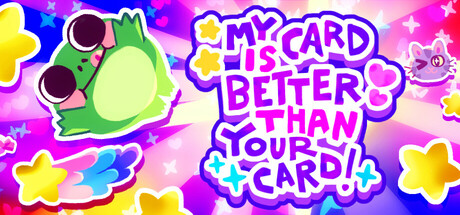
My Card Is Better Than Your Card!
by Utu Studios
The Verdict
“A brilliantly original roguelike deckbuilder where you craft every card with stickers — deceptively deep, undeniably charming, and occasionally brutally unbalanced.”
Overwhelmingly Positive
Fewer than 5% of Steam games with 1,000+ reviews achieve this.
Analysis by Ivan Z. Ganza · Methodology →
Quick Stats
644en
1,093 total (all languages)
637 analyzed
Current as of Apr 23, 2026
Oct 6, 2025
$14.99
Apr 23, 2026
2.5/day
Slowing
Metadata current as of May 2, 2026 · Source: Steam
Market Reach
≈32,000
≈$470.0K
Based on 1,093 reviews (all languages)
Based on review count × genre/age/price-adjusted Boxleiter ratio. Gross revenue before Steam’s 30% cut, refunds, and regional pricing.
Design Strengths
- Sticker-based card crafting lets players compose, reorder, and stack effects on any card mid-run — a genuinely novel mechanic reviewers say they've never seen in the genre
- Deceptively deep strategic complexity hidden beneath an approachable aesthetic, with multiple viable archetypes and combo paths that reward game knowledge
- Highly addictive 'one more run' loop — players consistently report losing 4–6 hours without noticing, with avg playtime of 22+ hours on the topic
- Vibrant, cohesive art style and whimsical playground theme that distinguishes the game visually from every genre peer
- Soundtrack remains engaging after 100+ hours — rare in the genre, where players typically mute music after a few dozen runs
- Accessibility ramp is well-designed: Relaxed and Normal difficulties serve new players without neutering depth for veterans
- Content volume punches above Early Access weight — 10 starter decks, 200+ stickers, 40+ toys, 15+ event types keep individual runs feeling distinct
Gameplay Friction
- RNG sticker distribution is the dominant structural flaw — enemy opponents receive synergized rare-sticker decks while players can be starved of useful stickers across multiple events, making outcomes feel luck-dependent rather than skill-dependent
- Hard difficulty amplifies RNG dependency to a breaking point, with specific archetypes (Vehicles, Insects outperforming Plants, Fish, Fantasy, Dino) making some runs unwinnable regardless of player skill
- Forced card acquisition every round causes deck bloat — opponents maintain slim, tuned decks while players must manage an ever-expanding hand with minimal removal options, pushing all builds toward draw/scry strategies
- Card construction UI becomes clunky at scale — excessive scrolling required to view the full card pool, board clutters with stickers, and no draw-pile visibility creates planning friction
- Run pacing becomes uneven — mid-game phases feel tedious once a strong deck is established, and battles in the second half of a run can become trivially easy before a brutal Week 3 spike
- Animation pacing has no speed-up option, slowing down mid-run momentum especially in longer combat sequences
- Toy (artifact) system feels underdeveloped — many toys rely on the fever mechanic which is opaque to new players, limiting the system's strategic contribution
Audience Profile
Ideal Player
A strategy-minded player who loves creative expression, enjoys building absurd combo engines, and wants their roguelike wrapped in wholesome, nostalgic playground charm.
Casual Friendliness
high
Player Archetypes
Not For
Sentiment Trend
stable
Sentiment steady at ~93% positive over the last 180 days (394 reviews).
Genre Context
Roguelike deckbuilders are a crowded genre defined by Slay the Spire's template — fixed card pools, static decks, incremental upgrades. This game inverts the formula entirely by letting players compose every card from scratch mid-run via a sticker system, a mechanical novelty that reviewers call unprecedented. Its cozy aesthetic positions it at the softer end of genre tone without sacrificing the strategic depth hardcore players expect.
Promise Gap
Audience Match
The store page pitches a 'playful' and 'wholesome' experience that targets a casual or family-friendly audience, but the actual player base skews toward experienced roguelike and deckbuilder enthusiasts who are drawn by mechanical novelty and strategic depth. The 'adorable' framing may undersell the game to its most likely buyers while slightly overpromising balance and freedom to casual players who encounter Hard mode.
Player Wishlist
- Multiplayer / PvP mode to battle friends with custom-built decks
- Persistent card or deck save system so custom creations survive failed runs (e.g. exportable card gallery)
- Creative / free-play sandbox mode with achievements disabled for experimentation
- Native controller support for proper Steam Deck handheld play
Churn Triggers
- Players running Hard mode who hit Week 3 with a weak sticker draw — the difficulty spike collides with the perception that the loss was RNG-determined, not skill-determined, triggering immediate dropout
- New players who spend the first run building a perfect custom card and then lose it permanently on run failure — the emotional cost of loss arrives before they understand the roguelike loop
- Players with 4–7 hours who encounter the bloated mid-game card construction process and find they're spending 75–80% of session time outside of dueling — session pacing misaligns with genre expectations
- Players who open the card pool UI for the first time and find the scrolling/clutter experience overwhelming before they've formed a strategic identity
Developer Priorities
Redesign sticker distribution to guarantee minimum rare-sticker access per run regardless of event RNG, and rebalance Hard difficulty with a fairer enemy scaling curve
Balance/RNG issues are the #1 negative signal (89 mentions, avg 5.8 helpful votes per review) and the primary reason negative reviews exist — fixing this converts the game's biggest detractor without changing what players love
Add a card removal / deck-pruning mechanic (e.g. a dedicated 'sell card' event or scissor tool) to let players maintain tight decks
Forced deck bloat (22 mentions) undermines the game's core identity of precise sticker crafting — players feel their opponent has advantages inherent to the game design, not earned by the player
Fix the card text / item description overlap bug that silently ignores card effects, and resolve the 10+ sticker UI breakage
The text-overlap bug is the single most helpful negative review (71 helpful votes) — it creates a trust gap where players cannot verify their cards work as described, which is fatal to a game built entirely around card crafting
Build a card/deck memento system — allow players to export or save a gallery of their custom cards (images + stats) between runs, and consider a sandbox/free-play mode
Losing a crafted card on run failure is a named churn trigger and the second most upvoted negative review (29 helpful votes); preservation of creative work directly addresses the emotional cost of the roguelike loop for this game's specific audience
Implement native controller / Steam Deck input support
The game is marked Playable on Steam Deck but requires trackpad mouse emulation — a gap between the official Deck label and the actual experience that generates negative Deck-specific reviews and caps handheld audience
Competitive Context
The most frequent comparison: reviewers call this the best roguelike deckbuilder since Balatro, with several stating they enjoy it more. One reviewer notes it offers 'atmosphere and life that Balatro lacked' while matching its replayability.
Used as the genre benchmark. Reviewers with 50+ hours say this game 'still has the sauce' where most deckbuilders eventually lose to STS. At least one reviewer states they are actively playing this over Slay the Spire 2.
Positioned as a thematic and mechanical peer — described as 'child-friendly Inscryption' and 'everything I love about Inscryption, but adorable.' Comparison is tone/structure-based, not a superiority claim.
Described as 'Monster Train without any restrictions' — reviewers cite its greater freedom in card-effect stacking as the key differentiator.
Described as a more accessible MTG where players build game-breaking synergies. MTG players call it their 'HEAVEN' and compare the sticker system favorably to MTG Unfinity.
One reviewer identifies mechanical overlap in complete control over card value and activation chaining — used as genre-positioning context, not a value judgment.
Multiple reviewers describe the game as a Balatro/Kabuto Park crossover and note shared 'Kindergartner genre' aesthetic DNA in the artwork.
Sentiment History
Sentiment over time
Playtime Sentiment
Sentiment by time invested
· 638 post-launch reviewsSentiment is consistent across all playtime ranges — players feel the same way whether they've played 2 hours or 200.
Competitive Benchmark
Compared to 586 similar games in the Strategy genre released in 2025.
Tags
Loading analytics...
Get more analyses like My Card Is Better Than Your Card!
Free reports today. Pro launches soon. No spam.