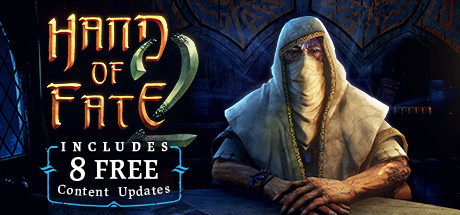
The Verdict
“A genre-defying D&D-meets-deckbuilder with a magnificent narrator — undermined by clunky combat and punishing late-game RNG.”
Very Positive
This puts the game in the top 30% of all reviewed games on Steam.
Analysis by Ivan Z. Ganza · Methodology →
Quick Stats
2,248en
5,762 total (all languages)
1,997 analyzed
Current as of Apr 25, 2026
Nov 7, 2017
$29.99
Apr 23, 2026
0.7/day
Slowing
Metadata current as of May 4, 2026 · Source: Steam
Market Reach
≈220K
≈$6.1M
Based on 5,762 reviews (all languages)
Based on review count × genre/age/price-adjusted Boxleiter ratio. Gross revenue before Steam’s 30% cut, refunds, and regional pricing.
Design Strengths
- Genre fusion of tabletop card-drawing, roguelike deck-building, choose-your-own-adventure storytelling, and action combat is genuinely novel — reviewers call it a niche with no direct competitors
- The Dealer's voice-acted narration functions as a responsive dungeon master, creating meta-narrative immersion praised as the game's best individual element
- 22 scenario campaign with distinct objectives per mission (escort, fortress defense, assassination) rather than repeated boss-path structures
- Companion system adds both strategic deck-rule manipulation and well-written personal storylines with unique encounter responses
- Per-scenario deck customization gives meaningful agency within randomized runs, rewarding strategic card selection over many hours
- Token/shard unlock system tied to card completion creates a layered progression loop sustaining 50–400+ hour engagement
- Minigame suite (dice, pendulum, card wheel) adds tactile variety and is learnable to the point of mastery, rewarding veteran players
- Significant improvement across every system compared to the original — broader card pool, better combat, more encounter variety
Gameplay Friction
- Combat inputs frequently fail to register — dodge, block, and counter presses are ignored by the engine, leading to deaths players attribute to input rejection rather than their own errors
- Excessive RNG in dice rolls, card draws, and chance events can erase hour-long runs with no meaningful player recourse; late-game scenarios stack multiple RNG checks consecutively
- Unskippable card-flip animations, transition scenes, and repeated Dealer dialogue consume an estimated 25–45% of total playtime on mission replays
- Late-game difficulty scaling relies on health-sponge enemy counts and compounding RNG penalties rather than increased mechanical complexity — specific missions (Strength, The Lovers, Judgement) called out as unfair
- Gear upgrade conditions require very specific situational kills (e.g., 25 kills while enemy is stunned) that feel arbitrary and grindy rather than organic to play
- Item inventory is pooled as random regional drops rather than carried forward, making individual gear progression feel unrewarding
- Keyboard and mouse control layout is ergonomically impractical for combat — movement on keyboard, attack on mouse, dodge/skills split across both; controller is effectively required
Audience Profile
Ideal Player
A patient narrative RPG fan who enjoys strategic deck-building and tolerates action combat as a secondary system, not a primary skill test.
Casual Friendliness
medium
Player Archetypes
Not For
Sentiment Trend
improving
Sentiment rose from 80% to 92% positive over the last 90 days (12 reviews vs 15 prior).
Genre Context
In the roguelike deckbuilder genre, Hand of Fate 2 occupies a rare hybrid position that adds real-time action combat and oral-narrative storytelling to a card-driven run structure — a combination that has no direct genre equivalent and predates the current deckbuilder boom by several years. Its primary weakness — clunky action combat — is a known liability for narrative-first deckbuilders that lack dedicated combat studios, and by genre standards its content depth and replayability ceiling are above average.
Promise Gap
Audience Match
The store page targets action-RPG players with combat-forward language, but the game's actual audience is narrative RPG and tabletop enthusiasts who tolerate rather than seek action combat. Players arriving expecting an Arkham-style brawler disengage quickly; players arriving expecting a D&D campaign with cards stay for hundreds of hours.
Player Wishlist
- Local co-op or party mode — multiple reviewers note the game's structure would suit couch co-op
- Animation speed toggle or fast-forward mode for card-flip and transition sequences during replays
- Modding support and Steam Workshop integration
- Additional character classes or starting archetypes to diversify repeat playthroughs
- Quick-retry button to restart failed missions without navigating back through menus
Churn Triggers
- First failed long run (~1 hour in) caused by a dice roll or card draw the player had no way to mitigate — this specific moment is cited by high-playtime negative reviewers as the breaking point
- Around the 10–30 hour mark, after campaign novelty fades, the repetition of the card-navigation → minigame → combat cycle triggers disengagement for players who haven't committed to token completion
- First encounter with late-game health-sponge scenarios (roughly the final third of the 22-mission campaign) causes players who enjoyed early missions to abandon the run and leave negative reviews
- Within the first 1–2 hours on keyboard and mouse, players who don't switch to a controller often quit due to combat feeling unplayable
Developer Priorities
Add an animation speed toggle or skip option for card-flip transitions, encounter cutscenes, and repeated Dealer dialogue
Unskippable animations are cited by ~98 reviewers as consuming 25–45% of replay playtime — this is the highest-friction quality-of-life gap and is the most actionable fix with low implementation risk
Audit and tighten input registration windows for dodge, block, and counter in combat — add visible input-confirmation feedback
Combat unresponsiveness is the single most-mentioned complaint (398 mentions) and the primary reason negative reviewers reject an otherwise praised game; perceived input failures cause players to attribute losses to the engine rather than themselves
Rebalance late-game scenario difficulty (Strength, The Lovers, Judgement, Poisoner of Greed) to reduce consecutive RNG-check stacking and enemy health scaling
356 RNG complaints and 134 difficulty-curve complaints together represent the largest combined friction cluster; late-game scenarios are where players with 20–40 hours invested disengage and flip to negative reviews
Redesign gear upgrade conditions to tie to natural play behavior (weapon use, kills) rather than hyper-specific situational requirements
68 reviewers cite grind-based upgrade conditions as immersion-breaking; this damages the token completion loop that drives the game's longest-playtime cohort
Add a remappable keyboard/mouse control scheme with a single-hand or WASD-native combat layout, and surface the controller recommendation prominently in the tutorial
48 reviewers report KB+M combat as near-unplayable; this is a direct churn trigger within the first 2 hours that could be mitigated by either control fixes or prominent onboarding guidance
Competitive Context
HoF2 is consistently called a direct upgrade in mechanics, content variety, combat fluidity, and card pool depth; many reviewers recommend skipping the original entirely
HoF2's counter/dodge combat is explicitly inspired by Arkham but reviewers broadly agree HoF2's implementation is clunkier, less responsive, and less refined than the source
Frequently cited to clarify genre: HoF2 is not a card-in-hand battler — reviewers use Slay the Spire as the contrast case to set correct expectations for newcomers
The Dealer's narrator style and the game's punishing RNG philosophy are favorably compared to Darkest Dungeon's design ethos
Reviewers recommend HoF2 to Inscryption fans citing shared dark, story-driven card-game atmosphere
One reviewer rates HoF2 above Hades in creative design despite significantly lower budget, citing HoF2's unique genre fusion
One reviewer argues Loop Hero delivers a more compelling roguelike deckbuilding experience, positioning HoF2 as weaker in a now-crowded genre
A reviewer cites HoF2 as surpassing FTL as their favorite long-session roguelike, praising its sustained engagement over many hours
Sentiment History
Sentiment over time
Playtime Sentiment
Sentiment by time invested
· 2,248 post-launch reviewsPlayers who invest more time rate this game significantly higher (+40pts) — a strong signal of a slow-burn experience that rewards patience.
Competitive Benchmark
Compared to 182 similar games in the Action genre released in 2017.
Tags
Loading analytics...
Get more analyses like Hand of Fate 2
Free reports today. Pro launches soon. No spam.